
Uber or Lyft Accident in Houston: Who Actually Pays Your Medical Bills?

Ready to listen
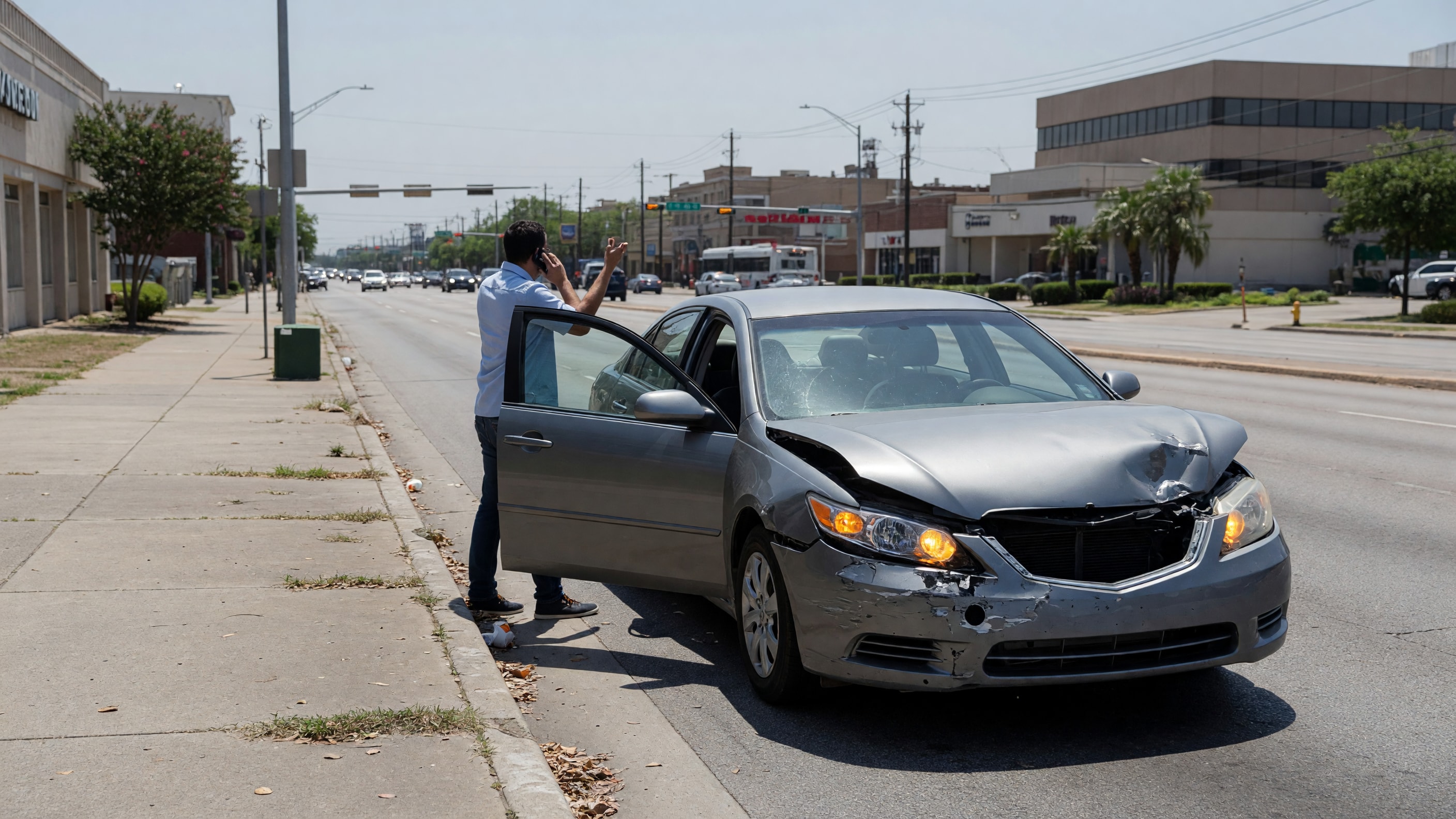
You're in the back seat of an Uber heading home after a long day, and suddenly — impact. Or you're in your own car and a Lyft driver runs a red light and T-bones you at the intersection. The airbags go off, the adrenaline hits, and within seconds you're asking the one question that will matter for the next several months: who is going to pay for this?
The answer is not simple, but it is knowable. Rideshare accidents in Houston operate under a three-phase insurance system that most passengers — and even most drivers — never fully understand until they're sitting in an emergency room with a stack of bills. This guide explains exactly how that system works, what the $1 million coverage window really means, and the steps you need to take in the first hours after a Houston rideshare crash.
#The Three Phases That Determine Everything
Texas Insurance Code Chapter 1954 — the state's Transportation Network Company (TNC) statute — divides every Uber and Lyft trip into three distinct coverage periods. The phase the driver was in at the exact moment of your crash controls which insurance policy applies, how much coverage is available, and who you'll be dealing with to recover compensation.
Phase 1 — App On, Waiting for a Ride Request
The driver has logged into the Uber or Lyft app but has not yet accepted a trip. This is the gap period, and it carries the weakest protection.
- Liability coverage: $50,000 per injured person / $100,000 per accident / $25,000 property damage
- This is contingent coverage — it only kicks in after the driver's personal auto insurance denies or exhausts coverage
- Most personal auto policies exclude rideshare use entirely, so in practice this TNC coverage often becomes the primary source
If you were hurt by an Uber or Lyft driver who was simply logged in and cruising near the Gulfton or Sharpstown corridors while waiting for a ping, this is the tier that applies.
Phase 2 — Ride Accepted, En Route to Pick Up Passenger
The moment the driver taps "Accept" in the app, coverage jumps dramatically.
- Primary liability: $1,000,000 combined single limit for bodily injury, death, and property damage
- This coverage is primary — it does not wait for the driver's personal policy to deny first
Phase 3 — Passenger in the Vehicle
From the moment you get in until the moment you're dropped off, you're covered under the same $1 million primary liability policy — plus an additional $1 million in uninsured/underinsured motorist (UM/UIM) coverage under Texas Insurance Code §1954.053.
This UM/UIM layer matters if your Uber or Lyft driver is hit by another motorist who has no insurance or too little insurance — a scenario that is distressingly common on Houston's freeways.
#What If the Other Driver (Not Your Uber/Lyft) Caused the Crash?
Rideshare accidents frequently happen when a third party — say, a distracted driver on I-10 West or a speeder on the 610 Loop — slams into the vehicle you're riding in. In that case:
- The at-fault driver's liability insurance is the first source of compensation
- Your Uber or Lyft's $1M UM/UIM policy fills the gap if the at-fault driver is uninsured or underinsured
- Your own Personal Injury Protection (PIP) — Texas requires at least $2,500 in PIP on all auto policies unless you rejected it in writing — pays for immediate medical bills and lost wages, no fault determination needed
The key takeaway: as a rideshare passenger during Phases 2 or 3, you have access to up to $1 million in liability coverage plus $1 million in UM/UIM coverage. That combination is significantly larger than most standard personal auto policies.
#If You Were Driving Your Own Car and a Rideshare Vehicle Hit You
You are a "third party" in this scenario. Your claim goes against the Uber or Lyft driver's liability coverage for the phase they were in. If they were on an active trip, that's the $1 million policy. If they were in Phase 1, you're working within the $50K/$100K/$25K limits (and potentially pursuing the driver's personal policy as well).
Texas is a modified comparative fault state. Under Texas Civil Practice and Remedies Code Chapter 33, you may still recover damages as long as you are not found more than 50% at fault — but your award will be reduced by your percentage of responsibility.

#Eight Steps to Protect Your Claim After a Houston Rideshare Crash
Acting quickly in the first 24–48 hours can make a substantial difference in the value of your case.
- Call 911. Get law enforcement to the scene. A Houston Police Department (HPD) or Harris County Sheriff's Office (HCSO) crash report is the primary official record of what happened. Texas Transportation Code Section 550.065 requires crash reports for accidents involving injury.
- Screenshot the app immediately. Before anything else, capture your ride status, the driver's name, trip ID, and the route map. This data gets harder to retrieve once the app registers the trip as complete or disputed.
- Do not close the app. Keep it open for documentation purposes. Even better — take a video of your screen showing the active trip details.
- Get driver and witness information. Collect the driver's name, vehicle license plate, insurance information, and any eyewitness contact details.
- Seek medical care that same day. Even if you feel "okay," adrenaline masks soft-tissue injuries, concussions, and internal trauma. Houston-area emergency rooms — Memorial Hermann TMC, Ben Taub, Houston Methodist — are available 24/7. Insurance companies and defense attorneys routinely argue that a gap between the crash and treatment means you weren't really hurt.
- Report the crash in the app. Both Uber and Lyft have in-app accident reporting. This formally notifies the TNC and starts the claim clock.
- Do not give a recorded statement to any insurance company without legal counsel. Insurance adjusters — including Uber's and Lyft's claims teams — are trained to use recorded statements to reduce your settlement. You have no legal obligation to provide one before consulting an attorney.
- Contact a Houston rideshare accident attorney early. Evidence like surveillance footage, black-box trip data, and witness recollections fades fast. An attorney can send a formal preservation demand to Uber or Lyft within days of the crash.
#What Damages Can You Recover?
In a Texas rideshare accident claim, you may be entitled to compensation for:
- Medical expenses — ER visits, hospitalization, surgery, physical therapy, medication, future care
- Lost wages and earning capacity — time missed from work, and reduced future earning ability if your injuries are lasting
- Pain and suffering — Texas does not cap non-economic damages in car accident cases (unlike some other contexts)
- Property damage — your vehicle if you were driving, personal belongings
Minor-injury rideshare cases in Texas often resolve in the $15,000–$40,000 range. Moderate injuries — herniated discs, surgeries, extended physical therapy — frequently yield $85,000–$225,000 or more. Serious and catastrophic injuries, where the $1 million policy limit becomes relevant, are evaluated individually based on long-term care costs, lost earning capacity, and permanent impairment. Every case is different, and outcomes vary depending on the facts.
#Why Houston Rideshare Accidents Are Uniquely Complex
Houston's rideshare market is enormous. The metro area has millions of registered Uber and Lyft trips each year, concentrated in corridors like Montrose, Midtown, Greenway Plaza, the Medical Center, and along major arteries like Westheimer, US-59/I-69, and I-45. Neighborhoods in Spring Branch, Pasadena, Aldine, and Katy all see significant rideshare traffic, particularly during late-night hours when impaired driving risk peaks.
The complexity comes from the layered insurance structure — potentially three or four policies (TNC corporate policy, driver's personal policy, your own policy, and the at-fault third party's policy) all interacting at once. Uber and Lyft are massive companies with professional claims teams whose job is to pay out as little as possible. An attorney who regularly handles rideshare cases in Harris County knows how to navigate that system.
If you or someone you love were hurt in an Uber or Lyft crash in Houston, our office works on contingency — no fee unless you recover.
📞 Call or text: (832) 404-2300 📍 Montrose: 1603 W. Alabama St. | East End: 6841 Avenue I 🗓️ Schedule your consultation
#Frequently Asked Questions
What if my Uber driver caused the crash — can I still recover compensation?
Yes, you may be entitled to full compensation even if your own driver was at fault. As a passenger in Phases 2 or 3, you have access to Uber or Lyft's $1 million liability policy regardless of which driver caused the crash. Contact an attorney before speaking to any insurance adjuster.
The Uber app was on but the driver hadn't accepted a ride yet. Does the $1 million policy apply?
No. In Phase 1 — app on, no ride accepted — only the limited contingent coverage applies: $50,000 per person, $100,000 per accident, $25,000 property damage. This is a critically lower ceiling that makes early legal counsel especially important.
Can I make a rideshare injury claim if I'm undocumented?
Yes. Texas law does not condition injury claims on immigration status. Medical expenses, lost wages, and pain and suffering are recoverable regardless of your status. Our consultations are confidential, and your immigration information is never shared without your explicit consent.
How long do I have to file a rideshare accident lawsuit in Texas?
Texas sets a general deadline for personal injury claims — consult an attorney promptly so your specific facts can be evaluated. The longer you wait, the more evidence disappears: app data, surveillance footage, witness memories. Do not wait until you think you have "enough" injuries documented; call as soon as possible.
What should I say to the Uber or Lyft claims team after a crash?
As little as possible before you have an attorney. Confirm the basic facts of the crash (it happened, you were involved), decline to give a recorded statement, and state that you are represented or seeking representation. That's it. Recorded statements can reduce your recovery significantly.
What if the at-fault driver fled the scene?
If you were a passenger in an Uber or Lyft during an active trip and a hit-and-run driver caused the crash, Uber/Lyft's $1 million UM/UIM coverage may apply to compensate you. A truck accident or hit-and-run attorney can help you access that coverage quickly.
#Related services
You may also like
What to Do If You Were Injured in a Houston Hit-and-Run
Injured in a Houston hit-and-run? Learn how to get your HPD report, use uninsured motorist coverage, and protect your rights. No fee unless we win.

Truck Accidents on I-10 and I-45 in Houston: Why These Cases Are Different
Hit by a semi-truck on I-10 or I-45 in Houston? Learn why commercial truck cases differ legally — and what evidence you must preserve immediately.
How Much Is a Car Accident Case Worth in Houston?
How Houston car accident case values are calculated — medical bills, lost wages, pain and suffering, and Texas factors that raise or lower your recovery.
This article is general information only and is not legal advice. Reading it does not create an attorney-client relationship.