
How to Prepare for Your Asylum Interview in Houston


The notice arrived: you have an appointment at the USCIS Asylum Office or a hearing date at the Houston Immigration Court. The fear is real — that interview may be the most important conversation of your life. What most people don't realize is that systematic preparation can fundamentally change the outcome. This guide walks you through exactly how to get ready.
#The Águila Method: Five Stages of Preparation
Our immigration practice uses the Águila Method — a five-stage preparation system built specifically for asylum seekers in Houston. An eagle doesn't attack blindly; it observes, plans, and moves with precision. That's how we prepare every case, one stage at a time.
The five stages are:
- Know your story — identify the key facts and the legal grounds that connect them to U.S. asylum law.
- Build the evidence — gather documents, witness statements, and country conditions reports.
- Write your personal declaration — a chronological, detailed, human narrative that becomes the spine of your entire case.
- Practice your testimony — mock interviews to eliminate inconsistencies and build confidence.
- Day-of logistics — the right place, the right time, the right documents in hand.
Each stage reinforces the next. Skipping one is like trying to fly with a broken wing.
#Affirmative vs. Defensive Asylum: Two Different Paths
Before you can prepare effectively, you need to know which type of asylum process you are in — because the location, the decision-maker, and the stakes are different.
Affirmative asylum: You filed Form I-589 with USCIS without an open removal proceeding against you. Your interview takes place at the USCIS Houston Asylum Office, located in the Greenspoint area (16630 Imperial Valley Dr, Houston, TX). The asylum officer is not a judge; their job is to evaluate whether you qualify. If your application is denied here, it is generally referred to the Immigration Court.
Defensive asylum: You are already in removal proceedings and are presenting asylum as a defense before an immigration judge. The Houston Immigration Court sits in the Mickey Leland Federal Building at 1919 Smith St., 14th Floor, Houston, TX 77002, open Monday through Friday, 8:00 a.m. to 4:00 p.m. The process is more formal, but your rights are the same.
In both settings, the deciding factor is identical: credibility and corroboration.
#Stage 1 — Your Story: The Personal Declaration
Your personal declaration is the spine of your entire asylum case. It is the document where you explain, in your own words, why you cannot return to your country safely.
A strong declaration must:
- Tell your story in chronological order, from the background of your life to the moment you arrived in the United States.
- Include real names, specific dates, and locations for every event that supports your claim.
- Explain why the harm happened — connecting it to one of the five protected grounds: race, religion, nationality, political opinion, or membership in a particular social group.
- Describe why your government cannot or will not protect you from that harm.
- Address why internal relocation within your country was not a safe option.
Most declarations run 10 to 25 pages. The goal is not length — it's precision. A minor inconsistency, like being off by a day, rarely causes problems. A serious inconsistency, like a different location or a different perpetrator than what you wrote on the I-589, can destroy your credibility before the officer or judge.
#Stage 2 — Evidence That Backs Up Your Account
Your testimony is essential, but evidence gives it weight. Gather:
- Personal documents: passport, birth certificate, identification, medical records documenting physical injuries or psychological treatment, police reports if you filed any.
- Witness statements: written, signed affidavits from people with direct knowledge of what happened. Include full name and contact information.
- Country conditions evidence: reports from Human Rights Watch, Amnesty International, and, where still useful after 2025, U.S. State Department human rights reports. These show that your experience fits a broader documented pattern.
- News articles and human rights organization documentation that corroborate the type of persecution you describe.
Every document not in English must include a certified translation. Submit additional evidence to the Asylum Office at least 7 days before your interview. Do not mail your originals — bring them with you on the day of your appointment.
#Stage 3 — Practicing Your Testimony
Knowing your story is not enough — you have to be able to tell it under pressure, out loud, to a stranger who is asking questions. The asylum officer or judge follows a predictable arc:
- Biographical questions (name, hometown, family)
- Your persecution events in chronological order
- Your flight and travel history to reach the United States
- Your fear of return and why your government cannot protect you
Officers test for consistency by asking the same things different ways and comparing your live answers against what you wrote on the I-589. Applicants who rehearse with an attorney come in with far greater clarity and composure.
Difficult questions you should be ready for:
- "Why didn't you go to the police and report what happened?"
- "Why didn't you move to a different part of your country?"
- "Why did you wait to apply for asylum after arriving in the United States?"
Remember: if you don't understand a question, you have the right to ask for clarification. That is not weakness — it is a procedural right, and using it correctly shows careful, honest engagement with the process.
#Stage 4 — Day-of Logistics
At the USCIS Asylum Office (affirmative asylum):
- Arrive 30 minutes early to allow time for security screening and check-in.
- There are few restaurants near the office. Pack water and a meal — interviews can run more than three hours.
- You must bring your own interpreter if you do not speak English fluently. The interpreter must be at least 18 years old, fluent in both English and your language, and may not be your attorney, a witness in your case, or a representative or employee of your country's government.
- As of May 18, 2026, attorneys are required to be physically present at asylum interviews — remote participation is no longer permitted except in limited circumstances.
At the Immigration Court (defensive asylum):
- Report to 1919 Smith St., 14th Floor, Houston, TX 77002. All visitors pass through a security checkpoint with a metal detector.
- Do not bring cameras or recording equipment.
- Dress professionally and arrive at least 20 minutes before your scheduled hearing.
#Document Checklist for Your Interview
Organize everything in a tabbed folder before your appointment day:
- Your USCIS appointment notice or court hearing notice
- Photo identification (passport, consular ID)
- Form I-94 Arrival-Departure Record if you received one
- A complete copy of your I-589 and every document you previously submitted
- Original birth certificates, marriage certificates, or other relevant personal documents
- Medical records (physical injuries, psychological treatment)
- Signed witness affidavits
- Country conditions packet (organized with a table of contents)
- Certified English translations of every document in another language
Make three complete sets: one for yourself, one for your attorney, and one extra in case the office requests a copy on the spot.
#Frequently Asked Questions
Does USCIS provide an interpreter for the asylum interview?
No — USCIS does not provide interpreters at asylum interviews, except for applicants who are deaf or hard of hearing. You must arrange your own interpreter if you are not fluent in English. That person may not be your attorney, a witness in your case, or someone connected to your country's government.
How long does an asylum interview take at the Houston USCIS office?
Interviews are generally scheduled to last about one hour, but many extend to three hours or more depending on the complexity of the case. Do not schedule other appointments that day, and arrive having eaten a good meal.
Does my undocumented immigration status affect my right to apply for asylum?
No. Immigration status does not bar you from applying for asylum or consulting with an attorney. Consultations at our office are completely confidential and do not affect any existing immigration proceeding.
Can I submit additional documents on the day of my interview?
You may bring originals of documents you have already submitted. For new evidence, submitting it to the Asylum Office at least 7 days before the interview is far more effective than trying to introduce it on the day. An attorney can guide you through the correct submission process.
What happens if USCIS denies my affirmative asylum application?
If USCIS denies your application and you do not have another valid immigration status, your case is generally referred to the Houston Immigration Court (1919 Smith St.). There, you may present your asylum claim defensively before an immigration judge. This transition is a critical moment — having experienced legal representation at this stage matters enormously.
Can your firm help me even if I already have a hearing scheduled at the Houston Immigration Court?
Yes. We handle both affirmative USCIS cases and defensive proceedings before the Houston Immigration Court. If you have a hearing coming up soon, contact us right away so we can assess your situation and prepare your case with the time available.
#Take the Next Step
Your asylum interview does not have to be the most frightening moment of your life. With a systematic approach — your story clear, your evidence organized, your testimony practiced — you walk into that room knowing exactly why you are there and what you need to say.
Our firm walks with you through every stage of the Águila Method, from the first conversation to the day of your interview. We have two Houston offices: Montrose (1603 W. Alabama St.) and East End (6841 Avenue I). We speak Spanish. Call or text (832) 404-2300, or schedule your consultation online.
To learn more about our immigration and asylum practice, visit our immigration page.
You may also like
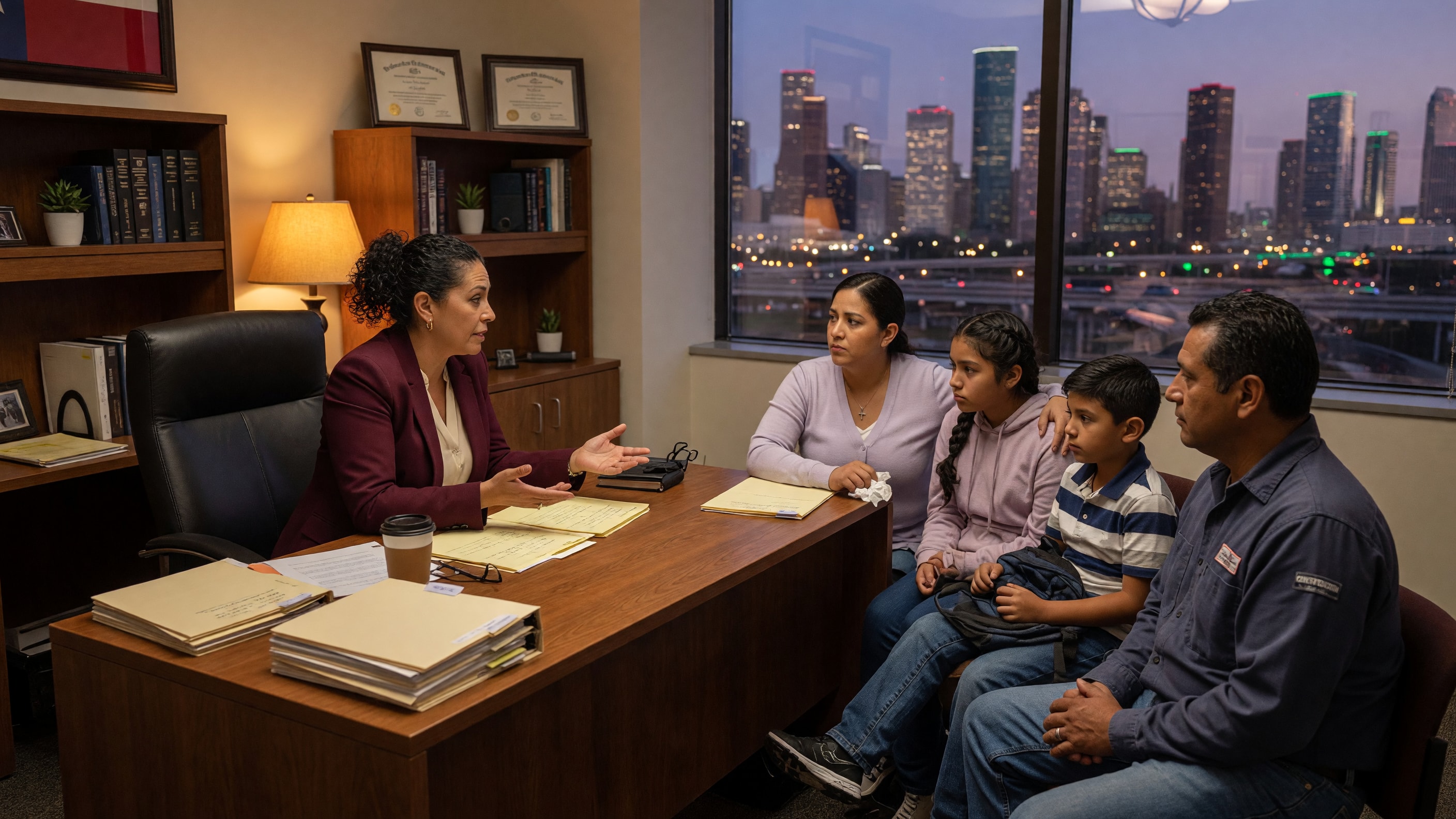
What Is Asylum? A Plain-Language Guide for Immigrants in Houston
Plain-language guide to asylum in Houston: who qualifies, affirmative vs. defensive asylum explained, step-by-step process, and why legal support matters.
Hit by an Uninsured Driver in Houston? Here's What Happens Next
One in five Texas drivers has no insurance. If an uninsured driver hit you in Houston, here's exactly how to protect your claim and pursue full compensation.

What to Do After a Car Accident in Houston
Just got in a crash in Houston? Follow this step-by-step guide to protect your health, your rights, and your injury claim under Texas law.
This article is general information only and is not legal advice. Reading it does not create an attorney-client relationship.