
Hit by an Uninsured Driver in Houston? Here's What Happens Next

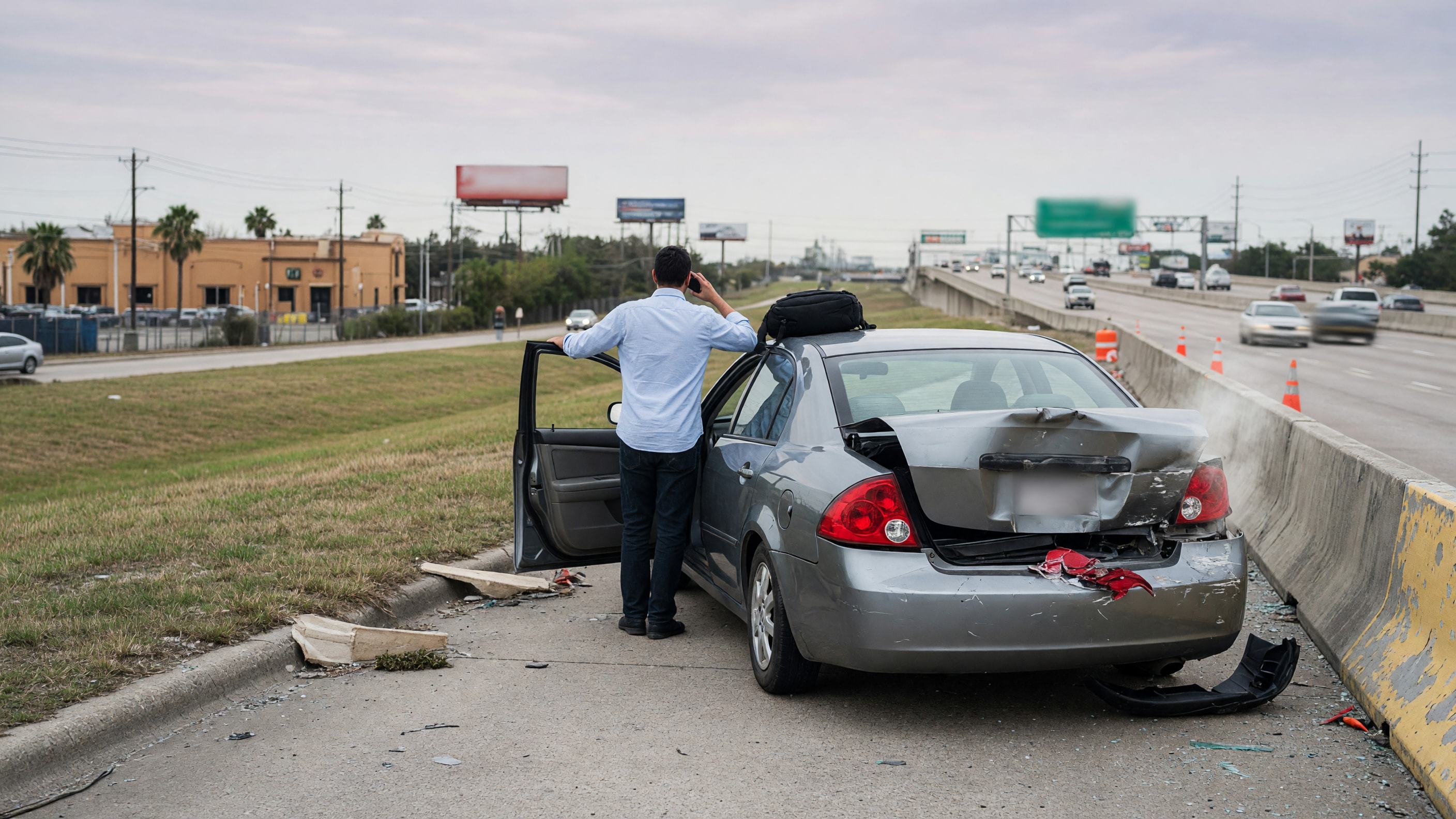
You're shaken, your car is damaged, and then it happens — the other driver hands you a piece of paper with no insurance information, or you confirm through the police that they have no coverage at all. That wave of panic is completely understandable. The person who hurt you cannot simply write you a check.
Here is the truth: being hit by an uninsured driver in Houston does not mean you are out of options. Texas law and your own insurance policy may give you more protection than you realize — but only if you act quickly and know what steps to take.
#How Common Is This in Houston?
Very common. As of 2025, an estimated 14–20% of Texas drivers are uninsured. In urban areas like Houston, advocates suggest the rate may be even higher. Harris County recorded 546 fatal crashes in 2024 alone — and on highways like I-10, I-45, and US-59/I-69, which rank among the most crash-prone corridors in the nation, the odds of encountering an uninsured driver are real.
The root cause is economics. Average Texas auto insurance premiums reached approximately $2,863 per year by 2025. About 82% of uninsured drivers say they simply cannot afford coverage. That reality puts the burden squarely on injured victims — and on their own policies.
#Your Four Recovery Paths
When an uninsured driver hits you, you generally have four avenues to pursue compensation:
- Your Uninsured Motorist (UM) coverage — This is usually the fastest and most effective path. If you have UM bodily injury coverage on your own policy, it steps in and pays for your medical bills, lost wages, and pain and suffering, up to your policy limits.
- Your Uninsured Motorist Property Damage (UMPD) coverage — A separate UM component for vehicle repairs, typically with a $250 deductible under Texas law.
- Your collision coverage — If you opted for collision, this pays for vehicle damage regardless of fault, though your deductible applies and rates may be affected.
- A direct lawsuit against the uninsured driver — Texas is a fault-based state. You can sue the at-fault driver and obtain a judgment. The challenge: most uninsured drivers lack the assets to satisfy a judgment, making this a longer and uncertain road.
For most injured Houstonians, a UM/UIM claim against their own insurer is the most practical first step.
#Understanding UM and UIM Coverage in Texas
Under Texas Insurance Code §1952.101, every auto insurer in Texas must offer you uninsured/underinsured motorist coverage. However, it is not automatically included — you can waive it in writing. Many drivers do, not fully understanding what they are giving up.
- Uninsured Motorist (UM): Applies when the at-fault driver carries no liability insurance or when it is a hit-and-run.
- Underinsured Motorist (UIM): Applies when the at-fault driver has insurance, but their limits — Texas's minimum is $30,000 per person / $60,000 per accident — are not enough to cover your actual damages.
Your UM/UIM limits cannot exceed your own liability limits. If you carry $100,000/$300,000 in liability coverage, you may elect up to the same in UM/UIM protection.
Check your policy right now. If you waived UM coverage, that decision cannot be undone retroactively — but an attorney can help evaluate your remaining options, including a direct lawsuit or collision coverage.
#Step-by-Step: What to Do at the Scene and After
Acting carefully in the hours and days after the crash protects your health and your legal rights.
- Call 911 immediately. A police report is essential for any insurance claim in Texas. Do not leave the scene without one. The officer's notation of "no insurance" is critical documentation.
- Document everything at the scene. Photograph vehicle positions, damage, skid marks, traffic signs, and any visible injuries. Get the names and contact information of witnesses before they leave.
- Seek medical attention the same day. Even if you feel okay, adrenaline masks pain. Gaps between the crash and your first medical visit are the single most common reason insurers reduce or deny UM claims.
- Notify your own insurance company promptly. Most Texas policies require notice within a specific window. Review your policy and report the accident quickly — delays can jeopardize your right to UM benefits.
- Order the official crash report. You can request it from TxDOT (Texas Department of Transportation) or the Houston Police Department. Provide it to your insurer with your claim.
- Consult a personal injury attorney before giving recorded statements. Once you file a UM claim, your own insurer has a financial interest in minimizing your payout. An attorney can level that playing field.
#What a UM/UIM Claim Can Cover
A successful UM/UIM claim in Texas may pay for:
- Emergency room treatment, surgery, hospitalization, and follow-up care
- Physical therapy and ongoing rehabilitation
- Prescription medications
- Lost wages if your injuries keep you from working
- Future lost earning capacity for long-term disabilities
- Pain and suffering, emotional distress, and loss of enjoyment of life
- Vehicle repair or replacement (under the UMPD component, with a $250 deductible)
The actual recovery depends on the facts of your case, your policy limits, and how your damages are documented. There is no guarantee of any specific amount — and the strength of your claim is built on the quality of your medical records, the police report, and early evidence preservation.
#When Your Own Insurer Becomes the Problem
Filing a UM claim is not the same as filing with a friendly helper. Your insurance company has every incentive to pay you as little as possible. Under Texas Insurance Code Chapter 541, your insurer is required to:
- Acknowledge your claim within 15 days of notice
- Accept or deny your claim within 15 business days after receiving all required documentation (extendable by 45 days for complex investigations)
- Act in good faith — no unreasonable delays, no misrepresentation, no lowball offers without justification
If your insurer drags its feet, disputes liability without basis, or makes an inadequate settlement offer, you may have a bad-faith insurance claim on top of your underlying UM claim. Texas law allows recovery of your actual damages, penalty interest, and attorney's fees in qualifying bad-faith cases.
This is precisely why many Houston injury victims hire a lawyer before — not after — dealing with their insurance company.
#Do You Have to Hire an Attorney?
You are not required to have an attorney to file a UM claim. But consider this: insurance companies use experienced adjusters and lawyers every day. Having an attorney who handles uninsured motorist cases in Houston means someone is negotiating on your behalf, preventing recorded statements that could hurt your claim, identifying every damages category, and standing ready to file suit if the insurer stalls or underpays.
At the Law Office of Kristopher A. Alvarez, PLLC, we handle car accident and uninsured motorist cases on a contingency basis — you pay no fee unless we recover money for you. Our offices serve the entire Houston area from Montrose (1603 W. Alabama St.) and the East End (6841 Avenue I).
If you've already read through what to do right after a collision, our guide on what to do after a car accident in Houston walks through the critical first hours in detail.
#Frequently Asked Questions
What if I don't have UM coverage on my policy?
If you waived UM coverage in writing, your own policy will not pay your UM claim. Your remaining options include: (1) filing a direct lawsuit against the uninsured driver — though collection can be difficult if they have few assets; (2) using your collision coverage for vehicle damage; and (3) applying your Personal Injury Protection (PIP) coverage for immediate medical costs if you have it. An attorney can review your full policy and identify every available avenue.
Can I still recover damages if the accident was partly my fault?
Texas follows a modified comparative fault rule. As long as your share of responsibility is less than 51%, you may still be entitled to recover compensation — but the amount may be reduced proportionally. An attorney can help evaluate how fault may be apportioned in your case.
How long does a UM/UIM claim take to resolve in Texas?
Simpler claims are often resolved within three to six months once medical treatment is complete. More complex cases — particularly those involving serious injuries, disputed liability, or insurer bad faith — may take twelve to eighteen months or longer. Every case is different, and rushing to settle before you understand the full extent of your injuries can significantly reduce what you receive.
What if the uninsured driver fled the scene (hit-and-run)?
A hit-and-run is covered under your Uninsured Motorist coverage, the same as if the driver had stayed and was confirmed uninsured. You will need a police report and, typically, physical contact between vehicles to trigger the UM coverage — your policy and state law govern the exact requirements. Report the incident to HPD or Harris County Sheriff immediately.
Does my immigration status affect my right to make a UM claim?
No. Your right to file an insurance claim in Texas is not affected by your immigration status. Confidentiality applies to all consultations with our office. If you were injured in Houston, you have the same legal right to pursue compensation as any other crash victim.
Can I accept the insurance company's first settlement offer?
You are not obligated to accept any settlement offer, and the first offer is rarely the highest the insurer is willing to pay. Once you sign a release and accept a settlement, you typically cannot go back for additional money — even if your injuries turn out to be more serious. Before signing anything, schedule a free consultation with a personal injury attorney to understand what your claim may actually be worth.
#Ready to Talk? We're Here.
A crash with an uninsured driver is stressful enough. You should not have to navigate the insurance maze alone. Call or text us at (832) 404-2300, visit kristopheralvarez.com/agendar to schedule a free consultation, or stop by either Houston office — Montrose or the East End. Se habla español.
You may also like

What to Do After a Car Accident in Houston
Just got in a crash in Houston? Follow this step-by-step guide to protect your health, your rights, and your injury claim under Texas law.

What Is Asylum? A Plain-Language Guide for Immigrants in Houston
Plain-language guide to asylum in Houston: who qualifies, affirmative vs. defensive asylum explained, step-by-step process, and why legal support matters.

How to Prepare for Your Asylum Interview in Houston
Step-by-step guide to Houston asylum interviews: what to bring, how to build your narrative, and the Águila Method that turns fear into preparation.
This article is general information only and is not legal advice. Reading it does not create an attorney-client relationship.