
What to Do After a Car Accident in Houston


A car accident happens in seconds — and then everything feels like it's happening at once. Your heart is racing. Maybe you're hurt. Other drivers are honking. You don't know what to say or who to call first.
Take a breath. You can get through this. The steps you take in the next few hours matter enormously — both for your health and for your ability to seek fair compensation later. This guide walks you through exactly what to do, in order, after a crash anywhere in Houston.
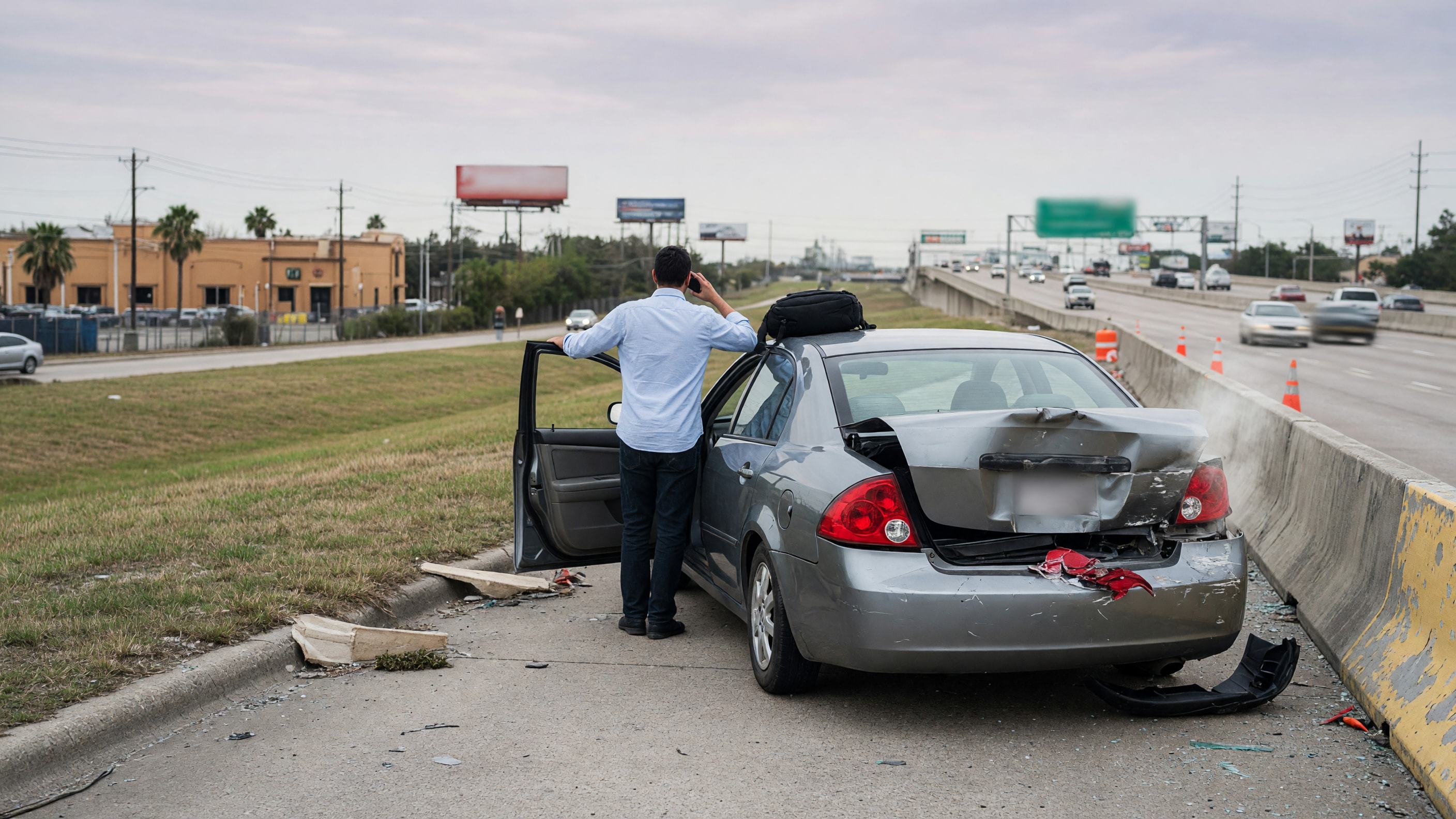
#Step 1: Check for Injuries and Move to Safety
Your first priority is always safety — not your car, not your phone, not the other driver.
- Check yourself and your passengers for injuries. Even if you feel fine, adrenaline can mask pain. Neck, back, and head injuries often show up hours or days later.
- If it's safe to do so, move your vehicle out of active traffic lanes and turn on your hazard lights.
- If anyone is seriously injured, call 911 immediately. Do not attempt to move someone who may have a spinal injury unless they are in immediate danger.
Houston's major freeways — I-10, I-45, US-59/I-69, the 610 Loop, and the Beltway 8 — carry some of the heaviest traffic in the country. If you're on one of them, get as far onto the shoulder or off-ramp as possible before stopping.
#Step 2: Call the Police — Every Time
In Texas, you are required to report a crash that involves injury, death, or property damage over $1,000. In Houston, that threshold is met by almost any collision involving a modern vehicle.
Call Houston Police Department (HPD) or Harris County Sheriff's Office depending on where the crash occurred. Wait for an officer to arrive and file an official report. This crash report becomes a critical document for any insurance claim or legal case.
- Ask the officer for the incident number before they leave.
- You can later request your Texas Peace Officer's Crash Report (CR-3) through the TxDOT crash records portal or through your attorney.
Never leave the scene before a report is filed. Doing so — even if you feel the damage is minor — can carry serious legal consequences in Texas.
#Step 3: Document Everything at the Scene
If you are physically able, gather as much evidence as possible while you're still there.
Exchange information with the other driver:
- Full name, address, phone number
- Driver's license number
- Insurance company and policy number
- License plate number
Photograph and video everything:
- Both vehicles and all visible damage
- The position of the cars before they're moved
- Street signs, traffic signals, skid marks, and road conditions
- Any visible injuries on yourself or passengers
- The surrounding area, including nearby cameras (businesses, traffic cams)
Talk to witnesses. Anyone who saw the crash can be invaluable. Get their name and phone number before they leave.
#Step 4: Seek Medical Attention — Even If You Feel Okay
Go to an emergency room, urgent care, or your doctor as soon as possible after a crash — ideally the same day.
This is not just about your health (though that's the priority). Gaps in medical care are one of the most common ways insurance companies reduce or deny injury claims. A medical record from the day of or day after the accident creates a direct link between the crash and your injuries.
Follow all treatment recommendations. Keep records of every doctor visit, prescription, and expense.
#Step 5: Notify Your Insurance Company — Carefully
You are generally required to notify your insurance company promptly after a crash. Report the basic facts: when, where, and that there was an accident.
What to be careful about:
- Do not give a recorded statement to the other driver's insurance company before speaking with an attorney. Adjusters are trained to ask questions that can undermine your claim.
- Do not accept or sign anything from any insurer without understanding what you're agreeing to.
- Do not describe your injuries as "minor" or say you feel "fine" — you may not know the full extent yet.
You have the right to have legal representation before speaking with insurance adjusters.
#Step 6: Understand Your Rights Under Texas Law
Texas follows a modified comparative fault rule. This means that even if you were partially at fault for the crash, you may still be able to recover compensation — as long as you were not more than 50% responsible. Your recovery is reduced by your percentage of fault.
There are also important time limits under Texas law for filing a personal injury lawsuit. Missing these deadlines can permanently bar you from seeking compensation. We strongly recommend consulting with an attorney as soon as possible after your accident — do not wait.
#Step 7: Call a Houston Car Accident Attorney
Insurance companies are experienced at minimizing payouts. An attorney levels the playing field.
The Law Office of Kristopher A. Alvarez, PLLC offers free, confidential consultations for car accident and personal injury cases in Houston. There is no fee unless we recover money for you — you pay nothing out of pocket to get started.
Attorney Kristopher A. Alvarez is bilingual in Spanish and English and serves clients across Houston, including the Montrose and East End communities. Whether you're dealing with HPD, a national insurance carrier, or an at-fault driver who is disputing liability, having an experienced attorney in your corner from the beginning makes a difference.
Offices:
- Montrose: 1603 W. Alabama St., Houston, TX 77006
- East End: 6841 Avenue I, Houston, TX 77011
- Call or text: (832) 404-2300
#A Note for Spanish-Speaking and Immigrant Clients
If you or a family member is undocumented or unsure about your immigration status, know this: your immigration status does not prevent you from seeking compensation after a car accident in Texas. You have the same right to be compensated for your injuries as anyone else.
All consultations at our firm are completely confidential. We will never ask about or disclose your immigration status. Se habla español — we are here to help you navigate this process in the language you're most comfortable in.
#Frequently Asked Questions
Do I need a police report to file a car accident claim in Houston?
You don't legally need one to file a claim, but a police report (CR-3) is one of the most important documents in any injury case. It records the officer's findings, the parties involved, and often includes a preliminary assessment of fault. Always call police to the scene and get the incident number.
What if the other driver doesn't have insurance?
Texas requires drivers to carry liability insurance, but not everyone does. If you're hit by an uninsured driver, your own uninsured/underinsured motorist (UM/UIM) coverage may apply. An attorney can help you identify all available sources of compensation.
How long do I have to file a car accident lawsuit in Texas?
There are important deadlines under Texas law for personal injury claims. The timeframe can vary depending on the circumstances of your case. Do not assume you have unlimited time — contact an attorney promptly to understand the deadlines that apply to your situation.
The other driver's insurance offered me a quick settlement. Should I accept it?
Be very cautious. Early settlement offers are typically made before the full extent of your injuries is known, and accepting one usually means signing away your right to seek more compensation later. Consult an attorney before signing anything.
My injuries didn't show up until a few days after the crash. Can I still make a claim?
Yes. Delayed onset of pain — especially for whiplash, soft tissue injuries, and concussions — is very common after car accidents. Seek medical attention as soon as symptoms appear and document everything. The key is creating a clear medical record that connects your injuries to the crash.
#Ready to Talk? We're Here to Help.
If you've been in a car accident in Houston, don't face the insurance companies alone. Call The Law Office of Kristopher A. Alvarez, PLLC at (832) 404-2300 for a free, confidential consultation. There is no cost and no obligation — and if we take your case, you pay nothing unless we win. Se habla español.
This article is for general informational purposes only and does not constitute legal advice. Reading this article does not create an attorney-client relationship. Laws and deadlines vary by case — consult a licensed Texas attorney about your specific situation.
You may also like
Hit by an Uninsured Driver in Houston? Here's What Happens Next
One in five Texas drivers has no insurance. If an uninsured driver hit you in Houston, here's exactly how to protect your claim and pursue full compensation.

What Is Asylum? A Plain-Language Guide for Immigrants in Houston
Plain-language guide to asylum in Houston: who qualifies, affirmative vs. defensive asylum explained, step-by-step process, and why legal support matters.

How to Prepare for Your Asylum Interview in Houston
Step-by-step guide to Houston asylum interviews: what to bring, how to build your narrative, and the Águila Method that turns fear into preparation.
This article is general information only and is not legal advice. Reading it does not create an attorney-client relationship.